
The Story Behind the Famous Ilkal Saree
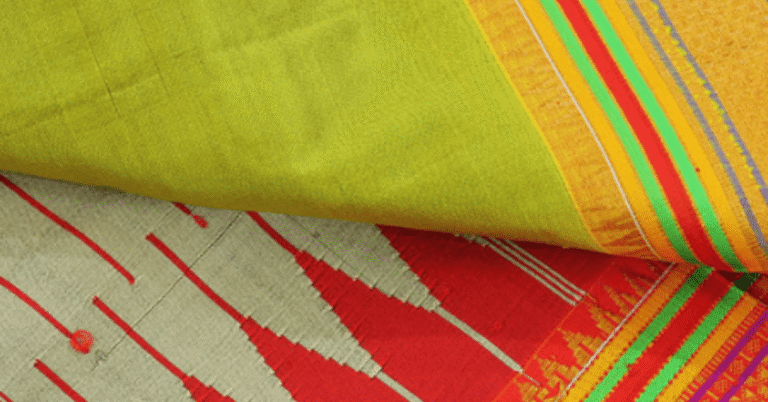
Every great saree begins with a story, and the story of the Ilkal saree begins in a valley. In the south-eastern corner of Karnataka’s Bagalkot district sits the town of Ilkal, where the rhythm of the loom has been part of daily life for generations. The saree that carries the town’s name is known for its bold red pallu, its broad contrasting border and a joining technique found nowhere else in Indian weaving.
But the fabric is only half the tale. Behind it are chieftains and traders, weaver families and pit looms, festival colours and hard-won skills. This is the story behind the famous Ilkal saree, told from the loom up. If you would like to see how that heritage looks in a finished drape, you can browse the Ilkal saree collection at Ilkal Pride while you read.
Where the Story Begins: A Town Built Around the Loom
Ilkal is a medium-sized town, and weaving has shaped its identity for as long as anyone can remember. Local tradition places the beginning of Ilkal weaving in the 8th century. The earliest official record is more recent but still impressive: the Gazetteer of the Bombay Presidency, published in 1884, mentions 684 looms operating in Ilkal in 1883.
The growth of the craft is often attributed to the patronage of local chieftains in the region, who valued fine cloth for court, temple and ceremony. Steady demand from courts, temples and households gave weaving families a reason to refine their skills, and the availability of local raw materials helped the industry take root. Over time, Ilkal became a recognised weaving centre, and its sarees found their way into homes far beyond the valley.
How an Ilkal Saree Is Made
To understand the story, it helps to watch the making. An Ilkal saree is woven on a traditional pit loom, where the weaver sits with their feet in a pit below the frame and works the pedals. The loom is usually fitted with a dobby or jacquard attachment to create the patterns. Weaving one saree takes about three to seven days, depending on how elaborate the design is.
The process has several stages:
- Yarn selection: cotton or art silk is chosen for the body, and silk for the border and pallu.
- Dyeing: yarn is coloured in the traditional palette of reds, greens and yellows.
- Warping: the warp threads for the body, border and pallu are prepared separately. The border and pallu share one colour, while the body is a contrast.
- Weaving: the body, the solid border and the pallu are woven, and the parts are joined using the Tope Teni technique.
- Finishing: the saree is checked, trimmed and prepared for the market.
The Tale of Tope Teni
Every craft has a secret, and for Ilkal it is Tope Teni. Instead of weaving the body and the pallu in one continuous stretch, the weaver prepares them as separate warps and then connects them with a chain of interlocked loops. The result is a saree whose two halves are literally knotted together into one fabric.
You can see the proof on the back of the saree, where the looped join is visible. Because of this technique, no two sarees are ever quite alike, since each is built from scratch rather than assembled from ready-made sections. Weavers speak of it with pride, and it is the feature that connoisseurs check first. There is something poetic in it too: two separate pieces, worked with patience, become a single whole. It is also why weavers guard the skill so carefully and teach it only to those willing to practise for years.
Colours That Carry Meaning
The colours of Ilkal are not chosen at random. Traditional shades include pomegranate red, brilliant peacock green and parrot green. Red in particular dominates the pallu, often woven with white motifs that stand out like carvings on a temple wall. For bridal wear, a shade called Girikumkum is used, linked to the sindhoor worn by married women in the region.
The patterns tell their own stories. Temple towers, chariots, lotuses, elephants, conch shells and palanquins appear again and again, reflecting the temples and festivals of Karnataka. The broad border, four to six inches wide, is sometimes described as echoing a field of crops. When a woman drapes an Ilkal, she wears a little of the landscape it came from.
A Craft Passed From Hand to Hand
Skills like these are not learned from books. They are passed down within families, from parents to children and from neighbours to apprentices, through years of watching and practice. A young weaver first learns to prepare yarn and set up a warp, and only later attempts the delicate Tope Teni join. Over time, the movements become instinct.
This is what makes handloom so valuable. The knowledge lives in people, not in machines, and it can vanish quickly if the next generation does not see a future in the craft. Every purchase of a handwoven Ilkal helps ensure that the skill continues to have a market, and a reason to be taught.
Weathering Change
The story of Ilkal has not been without challenges. Power looms can produce lookalike sarees faster and cheaper, and changing fashions have tempted many buyers towards ready-made fabrics. Yet Ilkal has endured, partly because its unique technique cannot be truly copied and partly because weavers and sellers have adapted.
Today, you will find Ilkal sarees in a wider range of colours, lighter body fabrics and contemporary combinations designed for younger buyers, all while the signature border and pallu remain intact. The Geographical Indication (GI) tag adds another layer of protection by recognising Ilkal as a product tied to a specific place and method. Tradition, in this case, has learned to move with the times without losing its identity. That flexibility is a big reason the saree remains relevant to new generations of wearers.
Carrying the Story Home
When you buy an Ilkal saree, you are not just purchasing a garment. You are taking home days of a weaver’s work, centuries of tradition and a technique that exists in one corner of India. That is a lot of story for a single drape.
A few simple habits help you appreciate it fully. Turn the saree over and look for the Tope Teni loops. Notice the border and how firmly it is woven. Read the pallu motifs as you would read a carving. Ask where and how the saree was made. Buying from a seller who values these details makes all the difference, and you can discover authentic Ilkal sarees at Ilkal Pride with that mindset in place.
The Story Continues With You
The Ilkal saree started as a local craft in a Karnataka valley and became one of the most admired handlooms in the country. Its story includes chieftains, weavers, colours and a technique that no one else uses. But it is also unfinished, because every wearer adds a chapter.
Wear your Ilkal to a wedding, a festival or an ordinary Monday, and it will do what it has always done: tell people where it comes from. When you are ready to begin your own chapter, visit Ilkal Pride and choose the saree that speaks to you.
Free shipping
on Orders Over ₹2000Secure Payment
100% risk-free shoppingSpecial Campaigns
Guaranteed SavingCustomer Service
Give us feedbackAbout Styler
At ILKAL’S PRIDE, you will witness the legacy of manufacturing the famous Ilkal sarees from generations to generations.
Quick Links
- tel: +91-9108142048
- -
- e-mail: info@ilkalpride.com
- Designed By Digisnare Technologies.