
How to Identify a Quality Ilkal Saree
Two Ilkal sarees can look almost identical in a photograph and feel completely different in your hands. One may be a carefully woven handloom that will serve you for decades. The other may be a rushed imitation that loses its shape after a few washes. Learning to tell them apart is one of the most useful skills a saree lover can develop.
The good news is that you do not need special equipment. Your eyes, your fingers and a little knowledge are enough. This guide walks through the practical checks that reveal the true quality of an Ilkal saree, whether you are shopping in person or examining one that has just arrived. To see well-made examples while you learn, you can view the Ilkal saree collection at Ilkal Pride.
Start With the Reverse Side
Always turn the saree over first. The hallmark of an Ilkal is the Tope Teni join, where the body warp and the pallu warp are connected by a series of interlocking loops. On the reverse side, you should see these loops clearly at the point where the pallu meets the body.
In a quality piece, the loops are even and neatly spaced, with no obvious gaps or loose sections. The join should feel firm when you tug gently on either side. A weak, uneven or missing join suggests either careless weaving or a machine-made copy. Since the pallu carries the weight of the drape, a strong join is essential for a saree that lasts. This is also the part that gets the most tension during wear, so it is the first place a poorly made saree shows its age.
Feel the Fabric
Touch tells you a great deal. The body of an Ilkal, typically cotton or art silk, should feel soft and breathable with a slightly crisp hand that relaxes with wear. The silk of the pallu and border should feel smooth, with a gentle natural sheen rather than a harsh, plastic shine.
Drape a corner over your hand. A good handloom falls with some body but is not stiff. If it feels slippery, clingy or overly glossy, it may contain more synthetic fibre than the seller indicated. Weight matters too. A well-woven saree has a pleasant substance in the hand without feeling heavy or flimsy, and it should feel comfortable against the skin for a full day of wear.
In a quality piece, the loops are even and neatly spaced, with no obvious gaps or loose sections. The join should feel firm when you tug gently on either side. A weak, uneven or missing join suggests either careless weaving or a machine-made copy. Since the pallu carries the weight of the drape, a strong join is essential for a saree that lasts. This is also the part that gets the most tension during wear, so it is the first place a poorly made saree shows its age.
Check the Weave Quality
Hold a section of the body up to the light. A quality weave looks even, with threads evenly spaced and no thin, see-through patches. Handloom naturally has tiny irregularities, such as a slightly raised thread or a subtle variation in texture. These are signs of handwork and are not defects.
What you should not see are large gaps, pulled threads, broken picks or areas where the pattern suddenly shifts. Use this rule of thumb: small, random character is a mark of authenticity, while repeated or large flaws are a mark of poor workmanship.
Inspect the Border Closely
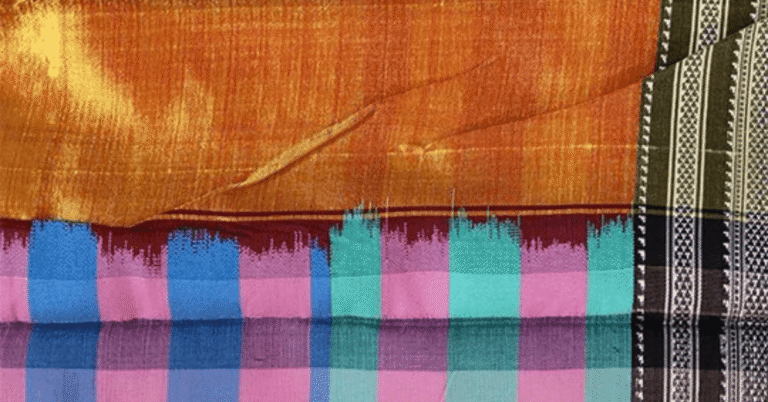
The border is the star of an Ilkal, so examine it carefully. It should be broad, usually four to six inches, and woven with the Kondi technique using three shuttles for a solid, crisp look. Run your eye along its length. The edges should be straight, the width consistent and the colour even, with no blurring where the border meets the body.
Check the selvedge, meaning the outer edge of the saree, for fraying or loose threads. Gently rub the border between your fingers. It should feel firmly woven into the body, not like a separate strip attached to it. A neat, well-anchored border is a strong indicator of quality.
Judge the Pallu
Traditionally, the pallu is woven in red silk with white patterns, featuring temple towers, chariots, lotuses, elephants and conch shells. In a quality saree, these motifs are crisp, symmetrical and properly aligned. Lines should be sharp, and the white should look clean against the red.
Confirm that the motifs are woven in, not printed. Woven motifs show a slight texture and appear on both sides of the fabric, while printed designs sit on the surface and often look flat. The pallu colour should be uniform, without patchy shading. Since the pallu is what people notice first, it deserves your most careful attention.
Check the selvedge, meaning the outer edge of the saree, for fraying or loose threads. Gently rub the border between your fingers. It should feel firmly woven into the body, not like a separate strip attached to it. A neat, well-anchored border is a strong indicator of quality.
Test Colour Fastness
Rich, saturated colour is a highlight of Ilkal sarees, but it should be stable. Look for even dyeing across the body, border and pallu, with no streaks or blotches. Traditional shades such as pomegranate red, peacock green and parrot green should look deep and consistent.
To check colour fastness, dampen a white cotton cloth and rub it lightly on a hidden corner of the saree, ideally after you have purchased it. A trace of dye on the cloth suggests the colour may bleed, which is not unusual with bright, richly dyed handloom. Wash such sarees separately for the first few washes, and ask your seller for care guidance.
A Simple Check for Silk Content
If you have a loose thread from your own saree, you can do a careful burn test in a safe place. Natural silk tends to burn slowly, smell like burnt hair and leave a brittle ash that crumbles easily. Synthetic fibres usually melt, form hard beads and smell chemical. Remember that Ilkal sarees legitimately use cotton and art silk in the body, so results should match the composition the seller stated. Treat this as a rough guide, not a laboratory verdict.
Handloom vs Mill-Made Lookalike
The table below summarises the differences you are most likely to notice. Remember that these are general tendencies, so use them alongside your own judgement.
| Feature | Genuine Handloom Ilkal | Mill-made Lookalike |
|---|---|---|
| Pallu join | Interlocked Tope Teni loops visible on the reverse | Flat, continuous or stitched line; sometimes a printed pallu |
| Border | Broad, crisp and firmly woven | Often narrower, printed or less defined |
| Weave | Small natural irregularities from handwork | Perfectly uniform, machine-regular finish |
| Feel | Breathable, with a distinct texture | Often slick or stiff, with a synthetic feel |
| Price | Reflects several days of handwork | Noticeably low for the look it imitates |
Care Keeps Quality Alive
Even the best Ilkal saree needs proper care. Dry cleaning is the safest choice for silk-rich pieces, especially early on. If you wash at home, use cold water and a mild detergent, avoid harsh scrubbing and dry in the shade rather than in direct sun. Iron on a low setting, ideally on the reverse side.
Store your saree wrapped in a soft cotton or muslin cloth, and refold it along different lines every few months to prevent permanent creases. With this care, a quality handloom rewards you with decades of wear.
Trust Your Eyes, Then Trust Your Seller
Knowing how to identify a quality Ilkal saree turns shopping into a confident, enjoyable experience. Check the Tope Teni loops, feel the fabric, inspect the border, study the pallu and test the colour. When a saree passes these checks, you can be sure you are holding real craftsmanship.
Equally important is buying from a seller who is open about their sarees. When you are ready, explore authentic Ilkal sarees at Ilkal Pride and put these tips into practice. If you are buying online, our checklist on what to verify before ordering an Ilkal saree pairs well with this guide.
Free shipping
on Orders Over ₹2000Secure Payment
100% risk-free shoppingSpecial Campaigns
Guaranteed SavingCustomer Service
Give us feedbackAbout Styler
At ILKAL’S PRIDE, you will witness the legacy of manufacturing the famous Ilkal sarees from generations to generations.
Quick Links
- tel: +91-9108142048
- -
- e-mail: info@ilkalpride.com
- Designed By Digisnare Technologies.